Let me be real with you — when I brought home my first puppy, a hyperactive Labrador mix named Cooper, I thought I had everything figured out. Toys? Check. Food bowls? Check. Crate? Umm… I grabbed the biggest one I could find, thinking “he’ll grow into it!”
Big mistake. Huge.
Cooper spent his first week treating one corner of that massive crate as his personal bathroom and the other corner as his “I’m terrified” zone. He looked lost in there, like a kid sleeping in a basketball court. That’s when I learned the hard truth: what size crate is right for my dog isn’t a one-size-fits-all answer.
If you’re reading this, you’re probably asking the same question I did. Maybe you’re bringing home a new puppy, upgrading for a growing dog, or just want to make sure your current setup isn’t causing hidden stress. Either way, you’ve come to the right place.
In this guide, I’ll walk you through everything I wish I’d known — from measuring your dog like a pro to understanding why bigger isn’t always better. We’ll cover breed-specific recommendations, puppy considerations, and even the subtle signs that tell you whether your crate is too big, too small, or just right.
Ready to give your furry friend the perfect den? Let’s dive in. 🐾
Why Crate Size Matters More Than You Think
Look, I get it. When you see a cute crate at the store, your first instinct might be to grab the biggest one and call it a day. After all, more space means more comfort, right?
Wrong. So, so wrong.
Dogs are den animals by nature. In the wild, their ancestors sought out small, enclosed spaces — caves, hollow logs, tight burrows — because those spaces offered protection from predators. That instinct hasn’t disappeared just because your pup sleeps on a memory foam bed now.
A crate that’s too large actually creates anxiety rather than comfort. When a dog has too much open space, they can feel exposed and vulnerable. Think about how you’d feel sleeping in the middle of a football stadium versus a cozy bedroom. Same principle.
Here’s what happens when the crate is the right size:
- Your dog feels secure — Like a protective hug
- House training becomes easier — Dogs naturally avoid soiling their sleeping area
- Less destructive behavior — A cozy den encourages calmness
- Better sleep quality — Your pup can fully relax without feeling exposed
On the flip side, a crate that’s too small is just as problematic. A dog that can’t stand up, turn around, or stretch out comfortably will develop physical discomfort and behavioral issues.
The sweet spot? Your dog should be able to:
- Stand without their head touching the top
- Turn around easily without squeezing
- Lie down with legs stretched comfortably
- Sit upright without hunching
This Goldilocks zone is exactly what we’re aiming for when figuring out what size crate is right for my dog.
How to Measure Your Dog Like a Pro
Alright, grab your measuring tape and a handful of treats — we’re getting hands-on. I promise this is easier than it sounds, and once you’ve done it, you’ll never guess at crate sizes again.
Measuring Length
Have your dog stand on all fours on a flat surface. I recommend doing this when they’re calm, maybe after a walk when they’re not bouncing off the walls.
- Start at the tip of the nose — right at the very end
- Measure to the base of the tail — where the tail meets the body, NOT the tip
Here’s the kicker: add 2 to 4 inches to this measurement depending on your dog’s size. For small breeds like Chihuahuas, stick closer to 2 inches. For larger dogs like Labradors, go with 3-4 inches.
Why? Because your dog needs that extra breathing room without their nose pressed against the bars.
Measuring Height
This part surprised me when I first learned it. Measure your dog while they’re sitting, not standing. Why? Some dogs are actually taller when seated due to their body structure.
Here’s the process:
- Get your dog into a comfortable sit
- Measure from the top of their head (or the tips of their ears if they’re pointy-eared breeds like German Shepherds) straight down to the floor
- Add 2 to 4 inches for comfort
I once measured my friend’s Beagle standing up and got 15 inches. When I measured him sitting — 17 inches! That 2-inch difference could have meant a crate that was too short for comfortable sitting.
The “Turn Around” Test
Once you’ve got your measurements and picked a crate, do this quick check:
Watch your dog enter the crate. Can they turn around fully without bumping into walls? If they have to back out or squeeze, the crate is too narrow.
I like to call this the “U-turn test” — if your dog can’t execute a perfect 180-degree turn, it’s time to size up.
Standard Crate Sizes and Breed Recommendations
Now that we’ve covered the measurements, let’s talk about what’s actually available on the market. Most dog crates come in these five standard lengths:
| Crate Size | Dimensions (Length x Width x Height) | Typical Weight Range | Best For |
|---|---|---|---|
| 24″ (Small) | 24″ x 18″ x 19″ | Up to 25 lbs | Chihuahua, Yorkie, Shih Tzu, Pomeranian |
| 30″ (Medium) | 30″ x 19″ x 21″ | 25-40 lbs | Beagle, French Bulldog, Westie, Mini Dachshund |
| 36″ (Large) | 36″ x 23″ x 25″ | 40-70 lbs | Cockapoo, Springer Spaniel, Bulldog, Corgi |
| 42″ (XL) | 42″ x 28″ x 31″ | 70-90 lbs | Labrador, Golden Retriever, Dalmatian, Boxer |
| 48″ (XXL) | 48″ x 30″ x 33″ | 90+ lbs | Great Dane, Greyhound, Bernese Mountain Dog, Mastiff |
Here’s a quick breakdown by breed:
Small Breeds (24″ Crate):
- Chihuahua
- Yorkshire Terrier
- Shih Tzu
- Jack Russell Terrier
- Maltese
- Papillon
Medium Breeds (30″ Crate):
- Beagle
- French Bulldog
- Miniature Dachshund
- Border Terrier
- West Highland White Terrier
- Cocker Spaniel (smaller individuals)
Large Breeds (36″ Crate):
- Cockapoo
- English Bulldog
- Springer Spaniel
- Corgi
- Australian Shepherd
- Standard Poodle (smaller individuals)
Extra Large Breeds (42″ Crate):
- Labrador Retriever
- Golden Retriever
- Dalmatian
- Boxer
- English Bull Terrier
- Labradoodle
Double XL Breeds (48″ Crate):
- Great Dane
- Greyhound
- Bernese Mountain Dog
- Mastiff
- Saint Bernard
- Irish Wolfhound
What Size Crate Is Right For My Dog? The Puppy Factor
Here’s where things get tricky — and where I made my biggest mistake with Cooper.
When you bring home an 8-week-old puppy, they’re tiny. Adorable. Pocket-sized. A Labrador puppy at 8 weeks weighs maybe 10-15 pounds. But that same puppy at 1 year old could be 65-75 pounds. That’s a LOT of growth in a short time.
So what size crate is right for my dog when they’re still growing?
The answer: buy for the adult, manage for the puppy.
Here’s what I recommend:
- Determine the adult size — Look at the parents if possible, or use breed standards as a guide
- Buy a crate that fits the adult dog — This saves you money and prevents multiple crate purchases
- Use crate dividers — Most quality crates come with divider panels that let you section off part of the crate for a growing puppy
When I finally got it right with Cooper, I bought a 42-inch crate (perfect for his adult Labrador size) but used a divider to give him about 24 inches of space as a puppy. Every few months, I moved the divider back a few inches until he fully grew into the space.
Why this works:
Puppies have the same den instincts as adult dogs. If you give them a huge crate too early, they’ll likely start using one end as a bathroom. The divider creates that cozy, den-like space they need while allowing room to grow.
Pro tip: Add extra bedding or a stuffed toy to make the smaller space feel even cozier. I used an old sweatshirt that smelled like me — Cooper loved it.
Can a Crate Be Too Big for a Dog?
Yes! And this is one of the most common mistakes I see new dog owners make.
I mentioned earlier that a too-large crate can cause anxiety, but let me explain exactly what happens and how to spot it.
Signs Your Crate Is Too Big
- Your dog uses one corner as a bathroom — This is the biggest red flag. Dogs naturally avoid soiling their sleeping area. If they’re treating part of the crate as a toilet, the space is too large.
- Your dog seeks other hiding spots — If your pup prefers curling up under the table, behind the sofa, or in a closet instead of their crate, the crate might feel too exposed.
- Your dog stays on one side — Watch how they sleep. If they’re always pressed against one wall or corner instead of spreading out, they’re trying to make the space feel smaller.
- Reluctance to enter — If your previously crate-trained dog suddenly avoids going in, size could be the issue.
Why This Happens
Think about it from your dog’s perspective. A crate that’s too large feels less like a den and more like a cage. In the wild, canines seek out small, enclosed spaces where they can’t be ambushed from any direction. A huge open space triggers that “I need to protect myself” instinct.
The sweet spot: Your dog should have enough room to stretch out comfortably but not so much that they feel exposed. If they can stretch out fully and still have 6 inches of empty space on all sides, it’s probably too big.
Adjustable Crates: The Smart Solution for Growing Dogs
If you’re dealing with a puppy or a dog that’s still growing, adjustable crates are a lifesaver. I wish I’d known about these sooner.
What Are Adjustable Crates?
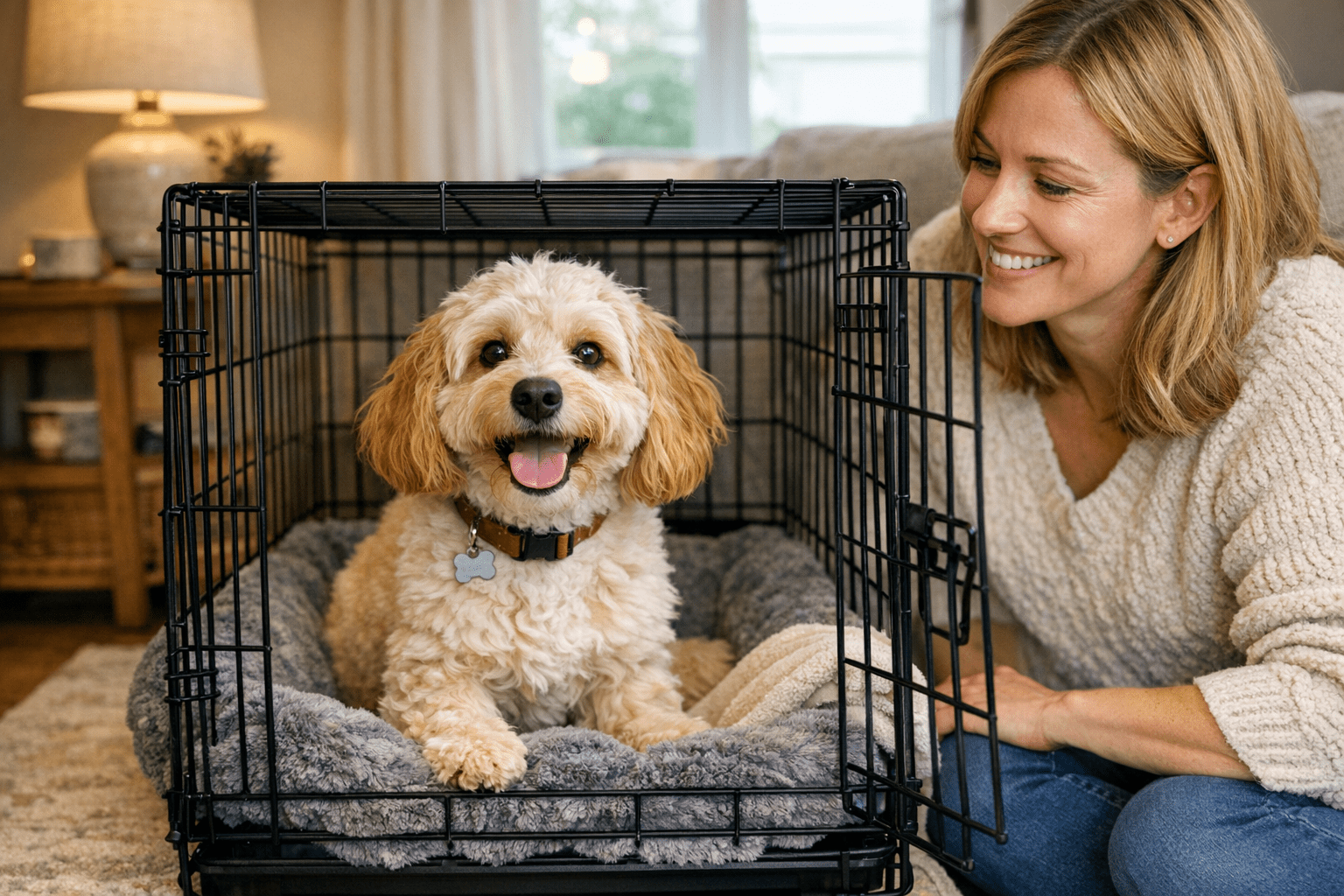
These are crates that come with built-in divider panels or adjustable walls. You can modify the interior space as your dog grows, so you buy one crate that lasts their entire life.
Types of Adjustable Crates
| Type | How It Works | Best For |
|---|---|---|
| Divider Panel | Removable metal panel that sections off part of the crate | Puppies growing into adulthood |
| Expandable Crate | Walls that slide out to increase size | Multiple dogs or temporary needs |
| Modular Crate | Sections that can be added or removed | Custom configurations |
My Experience with Adjustable Crates
When I finally got smart about crate sizing, I bought a 42-inch crate with a divider for Cooper. Here’s how I used it:
- 8 weeks to 4 months: Divider set at 24 inches
- 4 months to 8 months: Divider moved to 30 inches
- 8 months to 12 months: Divider at 36 inches
- 12 months+: Divider removed entirely, full 42-inch crate
Each adjustment took about 30 seconds. No new crate purchases, no transition stress, no potty accidents in the crate.
Cost savings: A quality adjustable crate might cost 100−150,butbuyingmultiplecratesasyourdoggrowscouldcost200-300+.
Crate Materials: Which One Fits Your Dog’s Needs?
Not all crates are created equal, and the material matters almost as much as the size. Here’s the breakdown:
Metal Wire Crates
Pros:
- Excellent ventilation
- Collapsible for storage
- Often include divider panels
- Easy to clean
Cons:
- Less privacy
- Can be noisy
- Not ideal for escape artists
Best for: Most dogs, especially those who like airflow and visibility.
Plastic/Vari-Kennels
Pros:
- Darker, den-like environment
- More secure for travel
- Quieter than wire
- Better insulation
Cons:
- Limited ventilation
- Heavier and bulkier
- Harder to clean thoroughly
- Fewer size options
Best for: Anxious dogs who prefer darkness, or for air travel.
Wooden/Hybrid Crates
Pros:
- Furniture-quality appearance
- Excellent insulation
- Great privacy
- Can double as end tables
Cons:
- Expensive
- Heavy
- Harder to clean
- Less portable
Best for: Owners who want the crate to blend with home decor.
Soft-Sided Crates
Pros:
- Lightweight and portable
- Easy to set up and take down
- Good for travel
Cons:
- Not chew-proof
- Less durable
- Not suitable for strong dogs
Best for: Well-behaved adult dogs, camping, or temporary use.
Setting Up the Perfect Crate: Beyond Just Size
Getting the size right is step one, but creating a space your dog actually loves requires a bit more effort.
What to Put Inside
- A comfortable bed or mat — Memory foam for older dogs, washable mats for puppies
- A safe chew toy — Avoid anything that could break into small pieces
- A familiar blanket — Something that smells like home
- Water — For longer stays, consider a crate-mounted water bowl
What NOT to Put Inside
- Pillows or loose bedding for puppies — They might chew and ingest stuffing
- Collars or tags — These can get caught on crate bars
- Food bowls — Unless you’re using the crate during mealtime
Location Matters
I made this mistake too — I put Cooper’s crate in the laundry room because I thought it needed to be “out of the way.”
Bad idea.
Dogs are pack animals. They want to be where the action is. Place the crate in a family area like the living room where your dog can still feel part of the group.
Best locations:
- Living room corner
- Bedroom (great for nighttime)
- Home office (helps with separation anxiety)
Crate Training Tips for Success
Knowing what size crate is right for my dog is useless if your dog hates being in it. Here’s how to make crate training positive:
The “Make It Magical” Approach
Every time your dog goes into their crate, something amazing should happen. Treats. Praise. Their favorite toy. A Kong stuffed with peanut butter.
My routine:
- Toss a treat into the crate and say “Go to bed!”
- When they enter, give another treat through the bars
- Close the door for 30 seconds, then open and reward
- Gradually increase time
Start Small
Day one: 5 minutes with the door open Day two: 10 minutes with the door closed Day three: 15 minutes while you’re in the same room Continue building up to longer periods
Never Use the Crate as Punishment
This is crucial. If your dog associates the crate with being “in trouble,” they’ll never feel comfortable there. Instead, use the crate for positive experiences only.
Signs You’ve Found the Perfect Crate Size
How do you know you’ve nailed it? Here are the telltale signs:
✅ Your dog enters willingly — They go in on their own, especially when tired ✅ They sleep stretched out — Not curled in a ball against one wall ✅ No bathroom accidents — The crate stays clean ✅ Relaxed body language — No panting, pacing, or whining ✅ They choose the crate — Your dog voluntarily naps there with the door open
If you’re seeing all of these, congratulations! You’ve found the perfect fit.
Frequently Asked Questions
How do I measure my dog for a crate if they won’t sit still?
Patience is key! Try measuring after a long walk when your dog is tired. You can also use treats to keep them in position. If your dog absolutely won’t cooperate, ask a friend to hold them steady while you measure. For wiggly puppies, take the measurement over several days and use the largest reading.
Should I buy a crate that my puppy will grow into?
Absolutely, but use a divider panel to make the space appropriate for their current size. Without a divider, a too-large crate can lead to potty accidents and anxiety. Most quality crates come with dividers, or you can purchase them separately.
What size crate does a Labrador Retriever need?
Most Labrador Retrievers need a 42-inch crate. This gives them enough room to stretch out, stand up, and turn around comfortably. However, some larger Labs or those with longer body structures may need a 48-inch crate. Always measure your individual dog rather than relying solely on breed recommendations.
Can I use the same crate for two dogs?
I wouldn’t recommend it. Dogs need their own personal space, especially in a crate. Sharing a crate can lead to resource guarding, fighting, and stress. If you have multiple dogs, each needs their own appropriately sized crate.
My dog refuses to use their crate. Is it the size?
Size could certainly be a factor, but there are other possibilities too. The crate might be in a bad location, your dog might associate it with negative experiences, or they might not be properly crate trained. Try making the crate more inviting with treats and toys, moving it to a family area, and ensuring it’s not too large or too small.
How long can I leave my dog in a crate?
Adult dogs can typically handle 4-6 hours during the day and 8 hours overnight. Puppies need more frequent breaks — usually 2-3 hours max during the day. Never leave a dog crated for more than 8 hours total in a 24-hour period without a break.
Conclusion
Figuring out what size crate is right for my dog doesn’t have to be complicated. Whether you’re measuring your current pup or planning for a new puppy, the key principles are simple:
- Measure length and height with 2-4 inches of extra space
- Buy for the adult size if you have a puppy, and use dividers
- Watch for signs that the crate is too big or too small
- Make it cozy with proper bedding, toys, and location
I learned through trial and error with Cooper, but you don’t have to. Get the measurements right the first time, and your dog will have a safe, comfortable den for years to come.
Remember, the perfect crate isn’t just about physical comfort — it’s about creating a space where your dog feels secure, relaxed, and at home. When you get it right, you’ll see it in the way they curl up contentedly, the way they choose their crate over other hiding spots, and the way they sleep soundly through the night.
Your dog deserves a perfect fit. Now you know exactly how to give it to them. 🐾❤️