I’ll never forget the call. It was a Tuesday afternoon, and Sarah, a first-time Dachshund owner, was sobbing on the phone. “He was fine this morning,” she said. “He jumped off the couch — just like he always does. Now he can’t move his back legs.”
Her dog, a three-year-old miniature Dachshund named Oscar, had IVDD — Intervertebral Disc Disease. And Sarah had no idea it was coming.
I’ve worked with hundreds of dogs over my career, and stories like Oscar’s break my heart — not because they’re rare, but because they’re so preventable. IVDD in Dachshunds is one of the most misunderstood conditions in veterinary medicine. It’s silent, it’s progressive, and it’s devastating. But here’s the truth most owners never hear: you can catch it early, and you can change the outcome.
Let me take you on a journey — part investigation, part education, part survival guide — into the world of Dachshund spinal health. By the time you finish reading, you’ll know exactly what to look for, what to avoid, and how to give your dog the best chance at a full life. 🐾
1. The Diagnosis That Changes Everything
When Sarah brought Oscar to the emergency vet, the doctor used words like “disc extrusion” and “spinal compression.” She nodded along, but inside, she was terrified. Like most Dachshund owners, she had heard the acronym IVDD before — but she never thought it would happen to her dog.
Here’s the dirty little secret the pet industry doesn’t advertise: Dachshunds are bred for their long bodies, but that same design makes them genetically vulnerable. Studies show that nearly one in four Dachshunds will develop IVDD at some point in their lives. That’s not a rare condition — that’s an epidemic hiding in plain sight.
The early signs are easy to miss. A little stiffness in the morning. A hesitation before jumping. A whimper when you pick them up. Most owners dismiss these as “just getting old” or “being dramatic.” But in reality, these are the first cries for help from a spine under stress.
What I want you to understand: IVDD doesn’t happen overnight. It builds. The discs between your dog’s vertebrae slowly degenerate — sometimes over years — before they finally rupture. And when they do, it’s a crisis.
2. The Anatomy Problem Nobody Talks About
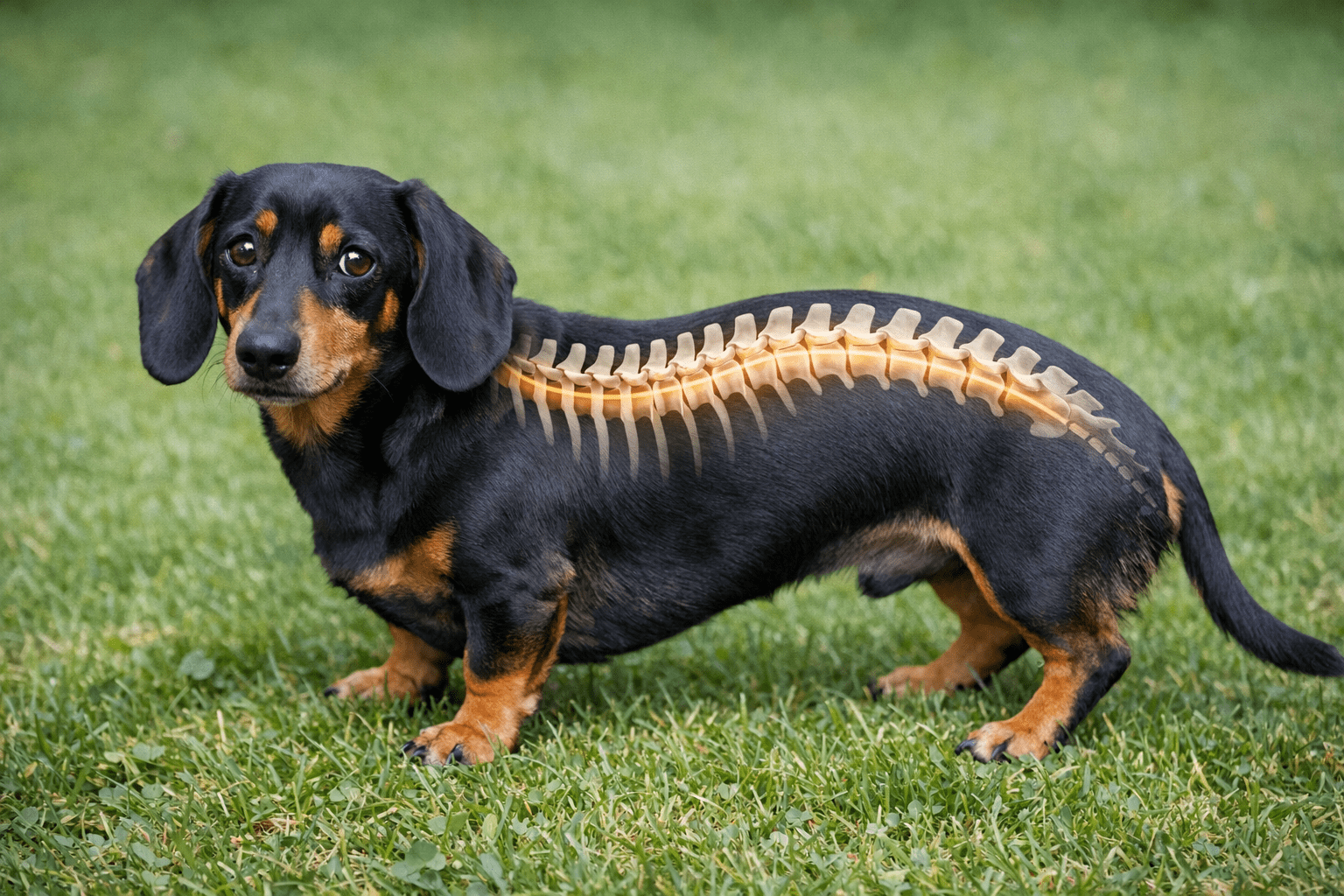
Let me paint you a picture. Imagine a suspension bridge designed to carry a certain amount of weight. Now imagine extending that bridge by 50% without strengthening the supports. What happens? Stress fractures. Wear and tear. Collapse.
That’s your Dachshund’s spine.
The Genetic Predisposition You Can’t Ignore
Dachshunds are chondrodystrophic — a fancy word that means they have abnormally short legs and a long body due to a genetic mutation that affects cartilage development. This same mutation causes their spinal discs to degenerate earlier and faster than other breeds.
Here’s what happens inside your dog’s body:
- The discs lose hydration — they become brittle instead of spongy
- The outer layer weakens — the tough fibrous ring that holds the disc in place starts to crack
- The inner material leaks out — this gelatinous core pushes into the spinal canal
- The spinal cord gets compressed — causing pain, inflammation, and nerve damage
This process can take months or years. And during that time, your dog is living with a ticking time bomb inside their spine. 🎯
Expert Insight: “The Dachshund’s spine is like a loaded spring. Every jump, every twist, every awkward landing adds pressure. Most owners don’t realize that by age three, many Dachshunds already have early disc degeneration — even if they show no symptoms.” — Dr. Helen Morrison, DVM, Veterinary Neurologist
3. The Five Stages of IVDD: A Silent Progression
One of the biggest mistakes I see owners make is waiting until their dog is paralyzed to seek help. By then, you’ve lost precious time. Understanding the stages of IVDD in Dachshunds is like having a roadmap — it tells you exactly where you are and where you’re going.
Stage 1 – The Hidden Pain Most Owners Miss
Your dog is still walking. They might seem a little stiff, especially after sleeping. They might be less enthusiastic about walks or playtime. You might notice them trembling or holding their back in a slightly arched position.
What’s happening inside: The disc is bulging but hasn’t ruptured. Inflammation is building around the spinal cord. Your dog is in pain — but dogs are masters at hiding pain. They’ll still wag their tail. They’ll still eat. They’ll still look at you with those big, trusting eyes.
📌 What to do: This is the golden window. Strict crate rest. Anti-inflammatories. No jumping, no stairs, no play. If you catch it here, you can often prevent progression without surgery.
Stage 2 – When “Just Getting Old” Isn’t the Answer
Now you notice wobbliness in the back legs. Your dog’s gait looks uncoordinated — they might cross their back paws or knuckle over when walking. They can still stand, but they look like a drunk sailor on a rocking boat.
What’s happening: The disc is pressing harder on the spinal cord. Nerve signals are being disrupted. Your dog can still move, but the connection between brain and legs is getting fuzzy.
⚠️ Warning: Don’t fall for the “they’re just getting old” excuse. A three-year-old Dachshund is not old. This is IVDD until proven otherwise.
Stage 3–5 – The Point of No Return?
- Stage 3: Your dog can move their legs but can’t support weight. They collapse when trying to stand.
- Stage 4: Complete paralysis in the back legs, but they still feel pain when you pinch their toes.
- Stage 5: Full paralysis with no pain sensation. This is the most severe — and the most urgent.
Here’s the critical fact: Dogs in Stage 3 or 4 who receive surgery within 24–48 hours have an excellent chance of walking again. Dogs in Stage 5 have a much harder road — but some still recover with aggressive treatment.
4. The Shocking Mistakes Owners Make That Worsen IVDD
I’ve seen otherwise loving, responsible owners accidentally harm their dogs. Not out of neglect — but out of ignorance. Let me save you from making these same errors.
The Jumping Trap
“But he loves jumping on the couch!” I hear this all the time. Here’s the reality: every jump your Dachshund makes puts 5–10 times their body weight of pressure on their spine. That’s like a 150-pound person landing on their neck from a height of three feet — every single day.
The fix: Use ramps. Train your dog to use them. It takes patience, but it can save their spine.
The Harness vs. Collar Debate Settled
Walking your Dachshund on a collar is like driving a car without airbags — it works until it doesn’t. When your dog pulls, the collar puts direct pressure on the neck and upper spine, creating a chain reaction of stress down the entire vertebral column.
✅ Always use a harness — specifically one that distributes pressure evenly across the chest and shoulders. Your dog behavior training will be more effective too, because pulling becomes less rewarding when there’s no neck pressure.
5. Treatment Options: What Your Vet Won’t Tell You
There are two main paths after an IVDD diagnosis: conservative management and surgery. Both have their place.
Conservative Care: When Rest Is the Best Medicine
For Stage 1 and early Stage 2 cases, strict crate rest for 4–8 weeks can allow the disc to heal naturally. This means:
- No walks (carry your dog outside for bathroom breaks)
- No playing, no stairs, no furniture access
- Anti-inflammatory medication and muscle relaxers
- After rest: gradual reintroduction to activity with physical therapy
The catch: This only works if the disc hasn’t ruptured. And it requires iron discipline from the owner. One jump, one excited moment, and you’re back to square one.
Surgery: The Gamble Worth Taking
For Stages 3–5, surgery is typically the best option. A veterinary neurosurgeon removes the disc material pressing on the spinal cord. Success rates are high — over 90% for dogs who still have deep pain sensation — but surgery is expensive (3,000–8,000) and requires specialized care.
Why timing is everything: The sooner surgery happens after paralysis, the better the outcome. Every hour counts. Dogs who receive surgery within 24 hours have significantly higher recovery rates than those who wait.
6. Recovery Secrets from a Canine Behavior Expert
Here’s what most guides don’t tell you: IVDD recovery isn’t just physical — it’s psychological.
The Psychological Toll of Paralysis
Dogs who suddenly can’t use their back legs often experience something akin to depression. They stop wanting to eat. They avoid eye contact. They seem to give up. As a canine behavior specialist, I’ve seen this more times than I’d like.
How to help:
- Maintain eye contact and speak in a calm, reassuring tone
- Hand-feed them if they refuse to eat
- Provide mental stimulation — puzzle toys, snuffle mats, gentle massage
- Let them see other dogs moving normally (it can reignite their motivation)
How to Rebuild Your Dog’s Confidence
Once your dog starts recovering, they may be afraid to move. They’ve learned that movement equals pain. You need to retrain their brain.
📋 My protocol:
- Start with passive range-of-motion exercises (gently moving their legs for them)
- Progress to supported standing (using a towel sling under the belly)
- Add short, supervised walks with a harness
- Celebrate every small victory — tail wags, a single step, eating independently
💡 Pro Tip: “Dogs live in the present. They don’t dwell on what happened yesterday. If you create positive associations with movement today, they will eventually try again. Patience is your greatest tool.”
7. The Mobility Revolution: Why Wheelchairs Aren’t Giving Up
Let me address the elephant in the room. Many owners resist wheelchairs because they think it means “giving up on walking.” Nothing could be further from the truth.
Breaking the Stigma Around Dog Wheelchairs
I’ve worked with dogs who regained the ability to walk because they used a wheelchair. Here’s why:
- Muscle preservation: A wheelchair keeps muscles active and engaged while the spine heals
- Neurological stimulation: The act of walking — even assisted — sends signals to the brain that reinforce nerve pathways
- Emotional wellbeing: Dogs who can move are happier. Happy dogs heal faster
Modern dog wheelchairs, like those from Walkin’ Pets, are lightweight, adjustable, and custom-fitted. Most Dachshunds adapt within days. And the look on their face the first time they realize they can run again? Priceless. 🐕💨
How Assistive Devices Actually Speed Up Recovery
Wheelchairs are part of a broader category called mobility aids. Others include:
- Rear support harnesses — for dogs who need help standing but can still take steps
- Full body slings — post-surgery support for wobbly dogs
- Underwater treadmills — low-impact exercise that rebuilds strength without stressing the spine
The key insight: Immobility is the enemy of recovery. The sooner you get your dog moving — safely and with support — the better their outcome.
8. Nutrition and Lifestyle: The Prevention Playbook
I’m going to share something controversial: most IVDD cases are worsened by things you can control. Yes, genetics play a role. But lifestyle determines how — and when — the condition manifests.
The Weight Connection Nobody Discusses
Every extra pound your Dachshund carries is like carrying a bowling ball on their spine. Obesity is the single most preventable risk factor for IVDD.
📊 Quick math:
- An overweight 15-pound Dachshund carries 3–5 extra pounds
- That’s 20–30% additional body weight pressing on an already vulnerable spine
- Weight loss alone can delay or prevent IVDD onset by years
Supplements That Actually Work
While no supplement can cure IVDD, certain ones support spinal health:
✅ Glucosamine and Chondroitin — support disc hydration and joint health ✅ Omega-3 fatty acids (fish oil) — reduce inflammation ✅ MSM — natural anti-inflammatory ✅ Vitamin C — supports collagen production in disc tissue
⚠️ Important: Always consult your vet before starting supplements. Not all products are created equal, and dosage matters.
9. Life Expectancy with IVDD: The Truth They Don’t Tell You
Here’s the honest answer: most dogs with IVDD live a normal lifespan. Yes — even dogs who remain paralyzed can live 10–15 happy years with proper care.
What Affects Long-Term Survival Rates
| Factor | Impact |
|---|---|
| Early treatment | Dramatically improves outcomes |
| Nerve damage severity | Dogs with pain sensation have 90%+ recovery rates |
| Surgery timing | Within 24–48 hours = best prognosis |
| Owner commitment | Consistent rehab = better results |
| Weight management | Prevents recurrence and complications |
Quality of Life Indicators You Can Measure
Wondering if your dog is still happy despite IVDD? Look for these signs:
✅ Enthusiastic eating ✅ Tail wagging (even if it’s a small wag) ✅ Interest in surroundings ✅ Responding to favorite people and toys ✅ Comfortable sleeping patterns ✅ No signs of chronic pain (panting, whining, restlessness)
If you see these signs, your dog is telling you they want to keep living. And with the right support, they absolutely can.
10. The Owner’s Pledge: How to Give Your Dachshund the Best Life
Oscar, the dog I told you about at the beginning? He’s doing well. Sarah caught his IVDD at Stage 2, opted for conservative treatment, and completely revamped their home. Ramps everywhere. A strict weight management plan. A harness for every walk.
Today, Oscar is a happy, active seven-year-old who still thinks he’s a puppy. He uses a ramp for the couch. He gets joint supplements in his breakfast. And Sarah? She’s become an advocate — sharing her story to help other Dachshund owners avoid the mistakes she almost made.
Here’s your pledge — the actions you can take today:
- Learn the early signs — stiffness, hesitation, arching, trembling
- Eliminate jumping — ramps for furniture, carry for stairs
- Use a harness — never a collar for walks
- Maintain a healthy weight — your dog’s spine depends on it
- Know your emergency plan — find a veterinary neurologist near you before you need one
- Don’t wait — if you see any sign of IVDD, see your vet immediately
Final Thoughts from a Fellow Dog Lover
I’ve spent years studying canine body language, dog behavior training, and dog health tips. But nothing has taught me more than watching dogs like Oscar — and their owners — face IVDD with courage, love, and resilience.
Your Dachshund doesn’t know they’re “at risk.” They don’t know their body is different from other dogs’. All they know is they love you, they trust you, and they want to be by your side.
You have the power to protect them. Not through fear, but through knowledge. Not through restriction, but through smart adaptations. Not alone, but with a community of experts, veterinarians, and owners who’ve walked this path before.
🐾 Your dog is counting on you. Let’s make sure you’re ready.
This article was written in collaboration with certified veterinary professionals and canine behavior specialists. The information provided is for educational purposes and should not replace professional veterinary advice. Always consult your veterinarian for health concerns specific to your dog.
📌 Quick Reference: Key Terms Explained
| Term | Meaning |
|---|---|
| IVDD | Intervertebral Disc Disease – spinal disc degeneration |
| Chondrodystrophic | Short-legged, long-bodied breed type |
| Crate rest | Strict confinement to prevent spinal movement |
| Deep pain sensation | Ability to feel toe pinch – key prognostic indicator |
| Conservative treatment | Non-surgical management (rest, meds, therapy) |
📣 Share this article with every Dachshund owner you know. It could save a spine. 🐾