Introduction
Let’s face it — when you bring home a new puppy, the first thing you want to do is take them everywhere, show them off, and burn off that endless puppy energy. I’ve been there. My own Labrador pup, Duke, once ran laps around the living room like he was training for the Olympics, and I thought surely a long walk around the block wouldn’t hurt.
Turns out, I was dead wrong.
You see, puppy exercise by age isn’t just a fancy concept from dog trainers — it’s one of the most critical aspects of raising a healthy, happy dog. Over-exercise can damage those soft, growing joints, leading to lifelong problems like hip dysplasia, elbow issues, and early-onset arthritis. And once that damage is done, there’s no undoing it. Trust me, I learned the hard way with Duke when he started limping after what I thought was a “moderate” hike.
The good news? Getting it right isn’t rocket science. In this guide, I’m going to walk you through exactly how much exercise your puppy needs at every stage, what activities are safe, and how to spot the warning signs that you’ve gone too far. Stick with me, and your pup will thank you with a lifetime of wagging tails and healthy joints.
Why Puppy Exercise by Age Matters More Than You Think
Before we dive into the nitty-gritty of timelines and minute counts, let’s talk about why this topic is so important. Puppies aren’t just mini adult dogs. Their bones, cartilage, and tendons are still developing, with growth plates — those soft areas at the ends of long bones — remaining open until anywhere from 12 to 24 months depending on the breed.
Here’s the kicker: over-exercising a puppy before those growth plates close can cause permanent damage. Imagine building a house on a foundation that hasn’t set yet. That’s what happens when you push a puppy too hard, too young.
I’ve seen it happen too many times. Friends who took their 4-month-old Goldendoodle on 2-mile runs, only to end up with a vet bill for a limp that never quite went away. Or the well-meaning owner who played fetch on concrete for an hour and ended up with a puppy that had to be on joint supplements for life.
The 5-minute rule — 5 minutes of structured exercise per month of age, twice daily — is your golden ticket here. But it’s not a ceiling, it’s a floor. Many puppies need even less. The real trick is reading your individual pup’s signals.
puppy exercise by age: 8 to 12 Weeks (2–3 Months)
At this stage, your puppy is basically a fluffy potato with legs. Seriously. They sleep 18–20 hours a day, and their idea of a big adventure is chasing a dust bunny across the living room floor. This is not the time for long walks or puppy playdates at the dog park.
Total structured exercise per session: 10–15 minutes, no more than twice daily.
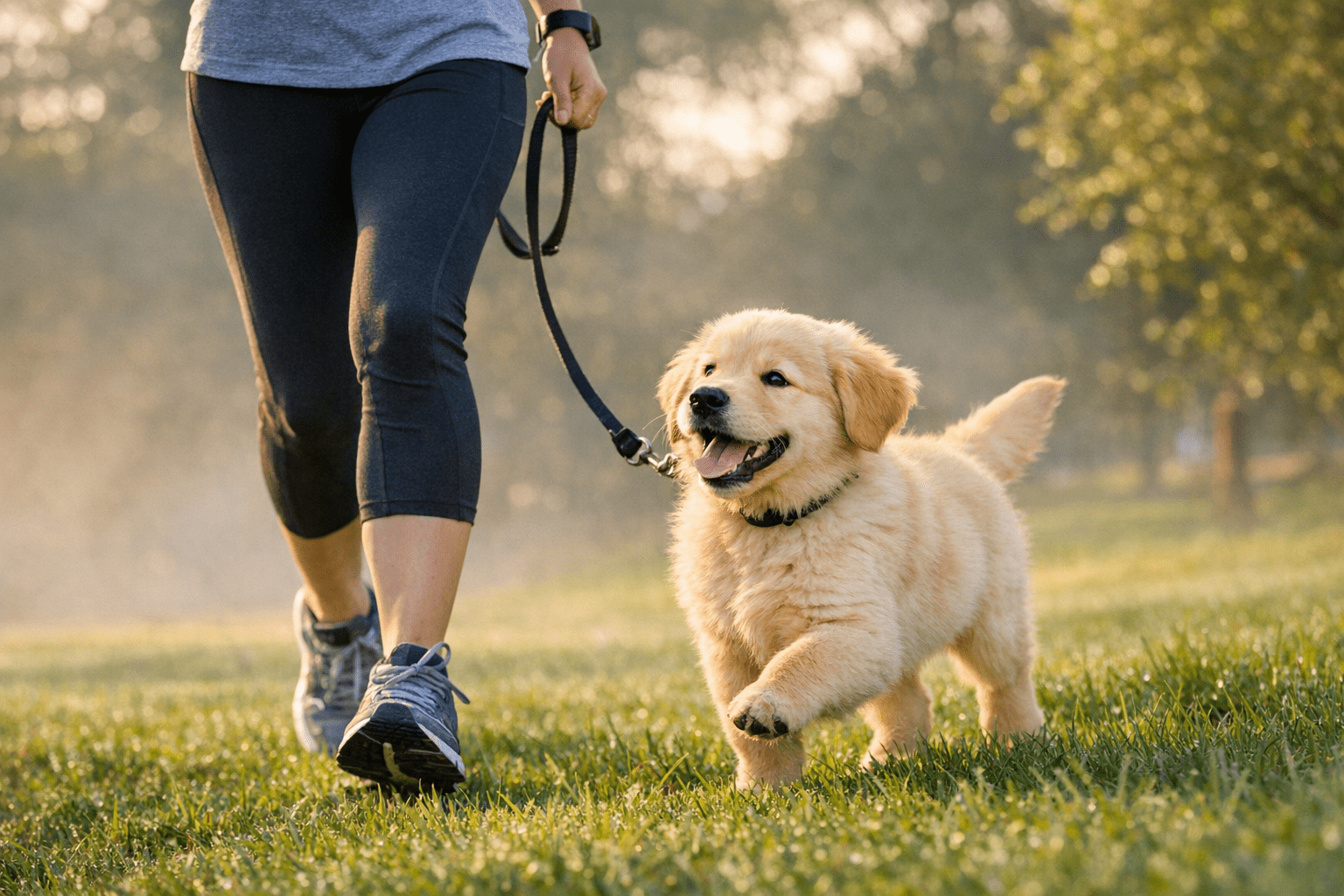
What does structured exercise look like at this age? Short, positive walks around the yard to get used to a collar and lead. Gentle play sessions in a puppy-proofed area where they can stop when they’re tired. Mental exercises — think sit, name recognition, or a treat puzzle — are far more exhausting for a young puppy than physical movement.
I remember Duke at 10 weeks would be absolutely done after a 10-minute session of learning “sit.” He’d flop down, give me the most dramatic sigh, and snooze for two hours. That’s exactly what should happen.
Warning signs of overexertion: If your puppy sits down mid-walk and refuses to budge, is panting heavily for more than a minute, or stumbles and looks uncoordinated, you’ve gone too far. Always carry them home if necessary. Never drag a puppy — their joints can’t take it.
Puppy Exercise by Age: 3 to 4 Months (12–16 Weeks)
Welcome to the “let’s explore everything” phase. Your puppy is more coordinated now, but still very much a baby. Those growth plates? Wide open. Bones? Soft as butter. This is where many owners make their first big mistake.
Structured exercise: 15–20 minutes per session, twice daily.
Play-based movement: Short bursts of free running in a safe, enclosed area for 5–10 minutes at a time.
What works great at this age? Gentle fetch on grass — keep throws short, maybe 5–10 feet max. A bit of controlled tug-of-war where you let your puppy win most of the time (nobody likes a sore loser). And introducing low steps, like 2–3 stairs, to help with body awareness.
What I’d strongly caution against? Jumping off furniture, running on hard surfaces, or repeated stair climbing. A friend of mine let her 14-week-old Beagle jump off the sofa repeatedly trying to catch a toy, and within a week the pup was limping. A trip to the vet confirmed a mild strain that thankfully healed with rest, but it could have been so much worse.
Puppy Exercise by Age: 4 to 6 Months
Here’s where puppies start looking like “real dogs” — but don’t be fooled. Those growth plates are still open, and coordination is only just improving. Your puppy may seem ready for more, but their body isn’t there yet.
Structured walks: 20–25 minutes per session, twice daily.
Total daily activity: Up to 45–60 minutes spread across the day, including free play.
This is the perfect time to introduce mental-physical combo exercises. I love playing “find it” — hiding treats in a room and letting Duke sniff them out. It’s mentally exhausting without any joint impact. Low-level agility tunnels or weave poles are also fantastic, as long as there’s no jumping involved.
Another hidden gem? Sniffing walks. Put your puppy on a long lead in a safe park and just let them sniff. Fifteen minutes of sniffing is more mentally tiring than an hour of running — and it’s zero impact.
Puppy playgroups shine at this age. Just keep sessions short — 15–20 minutes max — with similarly sized, well-vaccinated pups. I once made the mistake of taking Duke to a playgroup where he was the smallest, and he got bowled over by a rowdy Golden. No harm done, but it scared me enough to stick to size-matched groups thereafter.
Puppy Exercise by Age: 6 to 9 Months
Ah, adolescence. This is the teenage phase of puppyhood. Your dog has bursts of energy that seem to come from nowhere, followed by periods of total laziness. It’s confusing, but totally normal.
Structured walks: 25–30 minutes, twice daily.
Higher-intensity activity: Can increase to 45–60 minutes total per day, but still no forced running on hard surfaces.
This is where you can introduce short jogs on soft ground — grass or dirt trails, not pavement. Beginner agility obstacles at low heights work well, but keep jumps below 8–10 inches for small to medium breeds. Swimming, if your breed enjoys it, is absolutely brilliant as low-impact exercise. Always use a dog life vest and supervise constantly.
Here’s a reality check: adolescence is a common time for growth-related lameness to appear. Keep a close eye on your pup. If they start favouring a leg, don’t wait — see your vet. And those “zoomies” that everyone talks about? A 5–10 minute burst of crazy running counts as high-intensity exercise. Balance it with rest, not more activity.
Puppy Exercise by Age: 9 to 12 Months (Large Breeds) / 12 to 15 Months (Giant Breeds)
Patience, my friend. We’re nearly there, but not quite. Small and medium breeds may have closed their growth plates around 12–14 months, but large and giant breeds need more time — sometimes up to 24 months.
Exercise cap: Full adult-length walks of 30–45 minutes are safe, but high-impact activities should wait until growth plates are confirmed closed by a vet.
The gradual increase strategy is your friend here. Add 5 minutes to walks every two weeks during this phase. Continue mixing in mental work — nosework, advanced obedience — to prevent over-physical training. Controlled jumping can start at this point, but keep it low and limit repetitions to 5–10 per session.
Adult dog runs (1–3 miles) can begin after growth-plate closure, but start with 0.5 mile and build gradually over 4–6 weeks. Agility jumping at competition heights begins only after vet clearance. Hiking on moderate terrain is acceptable if your puppy isn’t panting excessively and takes regular breaks.
I know the temptation is real. Duke was 14 months old and looking every bit the adult dog. But his vet advised waiting until 18 months for running due to his breed, and I’m so glad I listened. His joints are still perfect at 8 years old.
General Safety Rules for All Ages
Let’s wrap this up with some hard and fast rules that apply no matter your puppy’s age.
| Area | Do This | Avoid That |
|---|---|---|
| Surfaces | Grass, dirt, sand, rubberised tracks | Pavement, concrete, asphalt for high-impact activity |
| Weather | Exercise in cool morning/evening; carry water | Midday heat above 25°C/77°F; icy or salted roads |
| Pacing | Watch breathing — should not be frantic for more than 1–2 minutes | Pushing past signs of tiredness (lying down, panting drops, glassy eyes) |
| Rest | Offer water every 5–10 minutes; crate/nap after exercise | Running again before a full rest break |
| Joint Stress | Low-impact play (swimming, sniffing, short tug) | Repeated landings, twisting turns, hard stops |
The 5-minute rule is a floor, not a ceiling. Many puppies will need less. The best “exercise meter” is your puppy’s behaviour: a calm, content pup who naps easily after activity is getting the right amount.
Common Myths About Puppy Exercise — Busted
Let me clear up a few misconceptions I hear all the time:
Myth 1: “A tired puppy is a good puppy.” Wrong. An overtired puppy is often hyperactive, destructive, and hard to settle. Real tired means they nap peacefully, not that they’re running on fumes.
Myth 2: “Puppies can self-regulate their exercise.” Only to a point. Puppies are like toddlers — they’ll keep playing until they collapse. You need to enforce rest breaks.
Myth 3: “All running is bad until the growth plates close.” Not true. Slow, short jogs on soft ground are fine after 6 months. The key is no forced, repetitive, high-impact activity on hard surfaces.
Myth 4: “Bigger breeds need more exercise.” Actually, large and giant breeds need less high-impact exercise than small breeds because their joints bear more weight. Don’t overdo it just because your Great Dane looks like a horse.
Frequently Asked Questions
How much exercise does a 10-week-old puppy need?
A 10-week-old puppy needs about 10–12 minutes of structured exercise twice daily. Stick to gentle play, short toilet trips, and basic training. Free play in a safe area is fine, but let them decide when to stop.
Can I take my 4-month-old puppy for a run?
No, I wouldn’t recommend it. At 4 months, growth plates are still open and joints are vulnerable. Stick to short, gentle walks and free play on soft surfaces. Running on hard ground can cause permanent damage.
What’s the best exercise for a teething puppy?
Mental activities are ideal during teething. Frozen Kongs filled with peanut butter, treat puzzles, and short training sessions are brilliant for tiring out a teething pup without stressing their mouth or joints.
My puppy still wants to play after exercise — is that okay?
It’s natural for puppies to want to keep playing, but you need to enforce rest breaks. Look for subtle signs of tiredness like slower reactions, lagging behind, or excessive yawning. End the session before they’re completely exhausted.
When can I take my puppy to the dog park?
Wait until your puppy is fully vaccinated (usually around 16 weeks) and consider their size and play style. Start with short, supervised sessions and ensure the park has separate areas for small and large dogs.
Is swimming safe for puppies?
Swimming is an excellent low-impact exercise for most breeds, but only if your puppy enjoys it. Use a dog life vest, supervise constantly, and limit sessions to 5–10 minutes initially. Rinse them thoroughly afterward to remove chlorine or salt.
Should I walk my puppy on concrete?
Short toilet walks on concrete are fine, but avoid structured exercise on hard surfaces until your puppy is fully grown. Pavement and asphalt provide no shock absorption, which stresses developing joints.
How do I know if I’m over-exercising my puppy?
Watch for warning signs: refusing to walk, heavy panting after short activity, stumbling, sleeping immediately after a short walk, or limping later that day. If you see any of these, reduce exercise immediately and consult your vet.
Conclusion
Raising a puppy is a marathon, not a sprint — and that’s more true for their exercise needs than anything else. The puppy exercise by age guidelines I’ve shared aren’t just arbitrary numbers; they’re backed by veterinary orthopaedics and decades of experience from breeders, trainers, and dog owners who’ve learned the hard way.
The golden rule remains: 5 minutes of structured exercise per month of age, twice daily. But even more important than that rule is your ability to watch, listen, and respond to your individual puppy.
When in doubt, err on the side of caution. Choose mental exercise over physical. Prioritise soft surfaces. Enforce rest breaks. And remember — a calmer puppy now means a healthier, happier dog for years to come.
Duke is 8 now, with joints as solid as the day he was born. And honestly? That’s worth every minute of careful exercise planning we did when he was small. Your puppy deserves nothing less. 🐾